
The Coca-Cola Route
Marangu Route
The original path to Uhuru Peak, with a bed in a hut every night.
- Duration
- 5 or 6 days
- Distance
- 64 km / 40 mi
- Summit
- 5,895 m / 19,341 ft
- Start gate
- Marangu Gate (1,860 m)
- Finish gate
- Marangu Gate (1,860 m)
- Sleeping
- Shared dormitory huts at Mandara, Horombo and Kibo
- Difficulty
- Moderate on the legs, though the quick climb makes altitude the real test
- Summit success
- Lower than the other routes, around 30 to 55 per cent on industry estimates, because the itinerary is short.
- From
- $2,050 per person
- Best months
- Jan, Feb, Jun, Jul, Aug, Sep, Oct
The route
The original path to Uhuru Peak, with a bed in a hut every night.
Marangu is the oldest organised trail on Kilimanjaro, and the earliest recorded ascents of the mountain used this path. It is also the only route where you sleep under a solid roof: three sets of permanent huts, Mandara, Horombo and Kibo, take the place of tents.
Its gate sits closest to Moshi of any route, so logistics are simple, and because you go up and come down on the same trail you finish exactly where you began. Sharing huts means less kit to carry and makes it the most affordable of the standard routes.
That convenience has a cost, and we would rather tell you plainly. The ascent is faster than on the longer tented routes and there is little room for acclimatisation, so the odds of reaching the summit are lower here than on Lemosho or Machame. For anyone climbing at height for the first time and chasing the summit above all else, one of those two is the wiser pick. Choose Marangu because you want the classic experience and understand the trade-off.
Trips are scheduled as five or six days including the arrival day; ask us how an added day on the mountain could ease the climb.
- The only Kilimanjaro route with permanent mountain huts
- Rainforest walking from Marangu Gate, with a short side trip to Maundi Crater
- Views of the jagged Mawenzi Peak while crossing the moorland
- A crossing of the saddle, the wide volcanic plain between Mawenzi and Kibo
- Gilman's Point at 5,681 m, then the crater-rim walk to Uhuru Peak
- A descent on the same trail that closes the loop at the gate
Day by day
The climb, day by day
Day 1
Marangu Gate to Mandara Hut
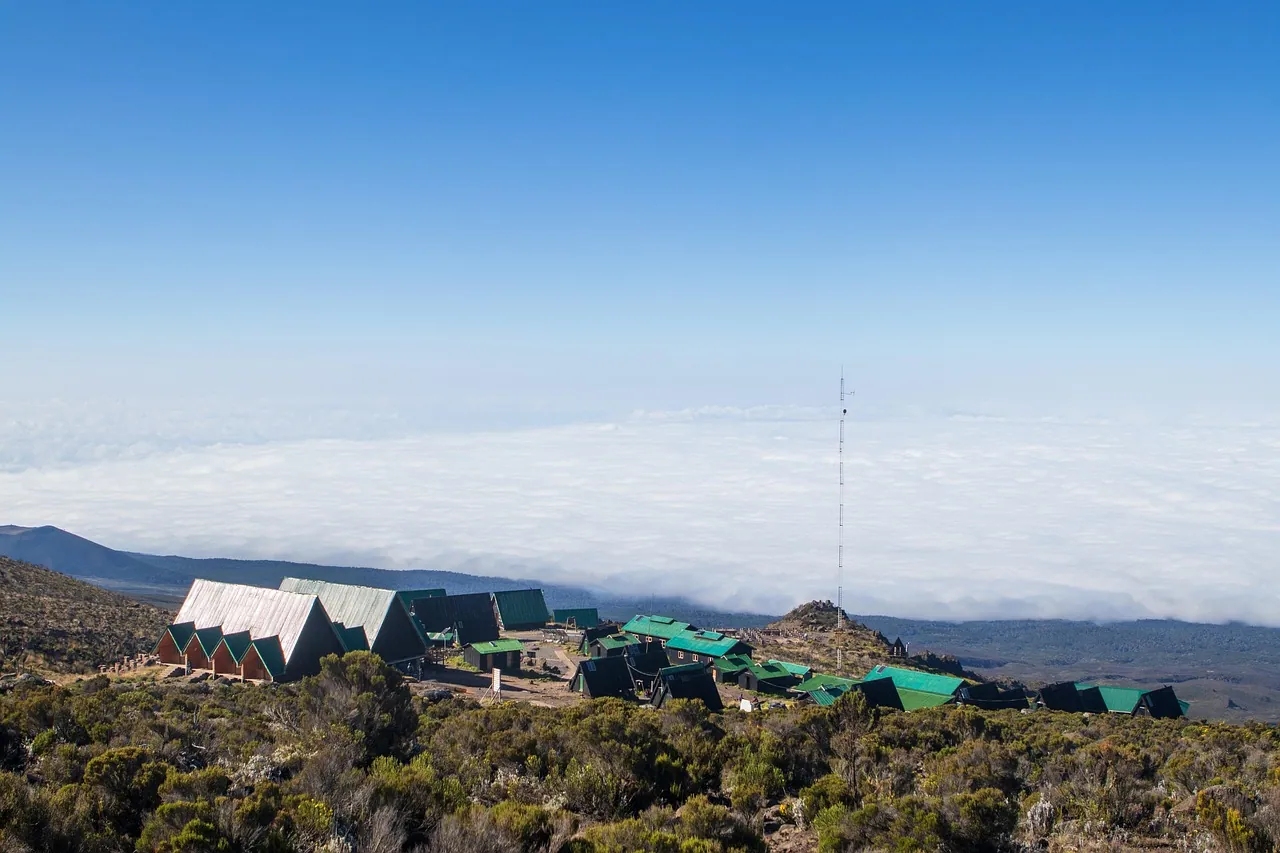
Mandara Hut
The path rises steadily through one of Kilimanjaro's loveliest rainforest stretches. Mandara is a cluster of A-frame huts set in a forest clearing. If legs allow, a short afternoon stroll to Maundi Crater is well worth it. Three to four hours of walking.
Huts are shared with other groups, so earplugs are a sensible thing to pack.
- 8 km / 5 mi
- 2,720 m / 8,924 ft
- Meals
- Lunch, dinner
Day 2
Mandara Hut to Horombo Hut
Horombo Hut
Forest turns into moorland as the climb goes on to Horombo, with Mawenzi Peak coming into view to the east. This is the longest and toughest stage of the route, five to seven hours, and altitude headaches at Horombo are common.
- 12 km / 7 mi
- 3,720 m / 12,205 ft
- Meals
- Breakfast, lunch, dinner
Day 3
Horombo Hut to Kibo Hut
Kibo Hut
You cross the saddle, a broad and bare volcanic plain between the two peaks, to reach Kibo Hut. The stone building sits exposed right beneath the summit cone. Five to six hours, with real altitude effects, so report any worrying symptoms to your guide straight away.
- 10 km / 6 mi
- 4,703 m / 15,430 ft
- Meals
- Breakfast, lunch, dinner
Day 4
Summit night: Uhuru Peak and back to Horombo Hut
Horombo Hut
Leaving Kibo around midnight, you climb steeply through volcanic scree to Gilman's Point at 5,681 m, then walk the crater rim west to Uhuru Peak. The return follows the ascent trail, about 5 km up and 15 km down, ten to fourteen hours, finishing at Horombo.
- 20 km / 12 mi
- 3,720 m / 12,205 ft
- Meals
- Breakfast, lunch, dinner
Day 5
Horombo Hut to Marangu Gate
Marangu Gate
A long final descent through moorland and rainforest, five to seven hours, takes you back to the gate where the trek began. Your summit certificate is presented there before the drive to your hotel.
- 20 km / 12 mi
- 1,860 m / 6,102 ft
- Meals
- Breakfast
Gallery
On the mountain
Photo credits: Uziuzi, CC BY-SA 4.0 via Wikimedia Commons; Unknown author, CC BY-SA 3.0 via Wikimedia Commons.
What's included
- Kilimanjaro National Park entry, hut and rescue fees, plus the conservation levy
- A lead mountain guide who speaks English, with one assistant guide for every three trekkers
- One porter per trekker, carrying a duffel capped at 15 kg
- A mountain cook preparing hot meals, full board throughout
- Dormitory beds at Mandara, Horombo and Kibo huts
- Emergency bottled oxygen carried with the team
- Pulse oximeter checks morning and evening at each hut
- A guide trained in wilderness first response
- Airport and hotel transfers, and the drive to and from the gate
- Summit certificate for everyone who reaches the top
- VAT and all Tanzanian taxes that apply
Not included
- International flights
- Tanzania entry visa
- Personal travel and medical insurance (compulsory for this trek)
- Personal trekking gear and clothing
- Gratuities for the mountain crew
Pricing
Price per person
The more climbers who share the crew and park costs, the lower the price for each. Prices are in US dollars.
Solo climber
$2,395
per person
Small group (2 to 4)
$2,195
per person
Group (5 or more)
$2,050
per person
Prices are per person and cover what is listed under what is included. Park fees are set by the authorities and can change, so the quote you accept is the price that applies. Gratuities and personal gear are not included.
Free guide
The Kilimanjaro Route Guide
Every route compared: distances, gates, camps, altitudes and the best months, in metric and imperial.
6
Routes compared
43
Daily stages mapped
5,895 m
Uhuru Peak (19,341 ft)
What is inside
- Every route side by side: days, distance, start and finish gates, and where you sleep
- A day-by-day table for each route with elevation and distance, in metric and imperial
- The best months to climb, shown as a month strip for every route
- What a climb typically includes, and what to ask any operator
- Straight answers to the questions climbers ask most
Who it is for. Anyone weighing up a Kilimanjaro climb who wants to compare the routes properly before choosing one.
- Free PDF, sent to your inbox
- Distances in metric and imperial
Questions
Good to know
It is a nickname for the easy-going, hut-based classic, in contrast with the tented Machame, which is known as the Whiskey Route.
The terrain is gentle and the beds are real, but that does not make it the easiest to summit. The quick ascent leaves less time to acclimatise, which is why success rates run lower than on longer routes.
No. The huts are shared dormitories, and other climbing groups use the same buildings, so expect company.
Ask us about the longer option when you enquire. Any extra day on the mountain gives your body more time to adjust before the final climb.
No technical skills are required. It is a walking route from start to finish, though good fitness helps, particularly for summit night.
Late June to October and January to February bring the driest weather and the clearest views.
Climb Marangu Route
Tell us your dates and fitness, and we will recommend the route and pace that suit you.