
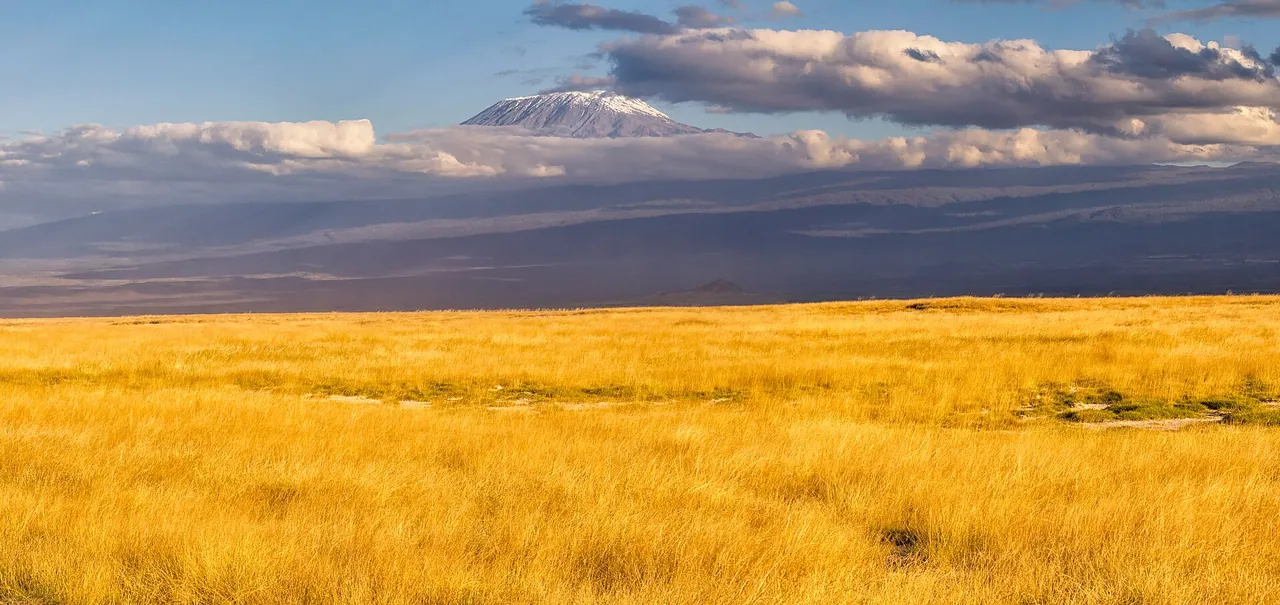
The Northern Approach
Rongai Route
Climb Kilimanjaro from the quiet, dry side, where the first days feel like a walk through game country.
- Duration
- 7 days
- Distance
- 65 km / 40 mi
- Summit
- 5,895 m / 19,341 ft
- Start gate
- Rongai Gate (1,950 m)
- Finish gate
- Marangu Gate (1,860 m)
- Sleeping
- Four-season sleeping tents at every camp, except the stone hut at Kibo
- Difficulty
- Moderate to challenging, with a gradual profile but a steep final slope on summit night
- Summit success
- Good, around 70 to 80 per cent on industry estimates, with a gentle approach and a steady gain in height.
- From
- $2,350 per person
- Best months
- Jan, Feb, Mar, Apr, May, Jun, Jul, Aug, Sep, Oct, Nov, Dec
The route
Climb Kilimanjaro from the quiet, dry side, where the first days feel like a walk through game country.
Nearly everyone else starts on Kilimanjaro's southern flank. The Rongai swings the other way, entering from the north near the Kenyan border, and the change is felt from the first hour. The slopes are drier and more open, the trail sees far fewer boots, and the lower forest holds wildlife: elephant, buffalo and eland are all seen here, so the early walking has more in common with a bush stroll than an alpine approach.
The climb itself is steady rather than brutal. Altitude builds in a fairly even line, with no scrambling and no airy ridge crossings, and a short day at Kikelewa Cave and a tarn camp beneath Mawenzi give the body a chance to catch up. The wide saddle between Mawenzi and Kibo is a long, bleak crossing of pumice and dust before the final push.
Because the northern side sheds the heavy rains that soak the south face, this is the sensible pick when you must climb in the long rains of March to May. We run the route over seven days, down via Marangu Gate, and the final slope to the rim is steeper than on the southern lines, so a good fitness base counts.
- Quiet trails: some days pass without meeting another climbing party
- Wildlife on the lower slopes, with elephant, buffalo, zebra and eland all possible
- A drier north-facing approach that holds up through the long rains
- A smooth, linear gain in height with no scrambling sections
- Mawenzi Tarn, a glacial pool under the jagged spires of Mawenzi Peak
- The lunar saddle crossing between Mawenzi and Kibo to the stone hut at Kibo
Day by day
The climb, day by day
Day 1
Rongai Gate to Simba Camp
Simba Camp
Heading north from Moshi, the road crosses open savannah and Maasai farmland toward the border, and the mountain's northern flanks appear in the distance for the first time. Beyond the park gate, an easy three to four hour walk begins through dry, light forest.
The low climb today is kind on the legs, so keep eyes on the trees and clearings for wildlife.
- 7 km / 4 mi
- 2,625 m / 8,612 ft
- Meals
- Breakfast, lunch, dinner
Day 2
Simba Camp to Second Cave Camp
Second Cave Camp
Woodland thins into moorland and the first giant lobelias appear. Views stretch north over the Kenyan plains and south toward Mawenzi. Expect four to six hours on the trail.
Altitude starts to register tonight: drink about four litres through the day and finish your dinner.
- 9 km / 6 mi
- 3,450 m / 11,319 ft
- Meals
- Breakfast, lunch, dinner
Day 3
Second Cave Camp to Kikelewa Cave Camp
Kikelewa Cave Camp
A short three-to-four-hour day across stark, open moorland with Mawenzi filling the eastern horizon. Your guide will suggest an easy afternoon walk to help the body adjust.
A gentle wander after lunch does more for acclimatisation than lying in the tent.
- 5 km / 3 mi
- 3,600 m / 11,811 ft
- Meals
- Breakfast, lunch, dinner
Day 4
Kikelewa Cave to Mawenzi Tarn Camp
Mawenzi Tarn Camp
A steep climb brings you to the tarn beneath Mawenzi's rock spires. It is a high point reached before sleeping, similar in purpose to the Lava Tower stop on other routes. Allow three to five hours.
Headaches are common at this height; tell your guide how you feel at each check.
- 4 km / 2 mi
- 4,330 m / 14,206 ft
- Meals
- Breakfast, lunch, dinner
Day 5
Mawenzi Tarn to Kibo Hut
Kibo Hut
A four-to-six-hour crossing of the saddle between Mawenzi and Kibo, a landscape of volcanic dust and pumice. You sleep in a stone hut rather than a tent, the one exception on this route, and rest early before the summit attempt.
The saddle is long and exposed, so walk slowly and save energy for midnight.
- 9 km / 6 mi
- 4,703 m / 15,430 ft
- Meals
- Breakfast, lunch, dinner
Day 6
Summit night to Uhuru Peak, then down to Horombo Camp
Horombo Camp
Leaving near midnight, you climb the north-eastern slope to the crater rim at Gilman's Point (5,681 m), then follow the rim to Uhuru Peak. The return drops via the southern path to Horombo, for a total of ten to fourteen hours on foot.
The final slope is steeper here than on the southern lines, so keep your pace measured from the start.
- 17 km / 11 mi
- 3,720 m / 12,205 ft
- Meals
- Early snack, breakfast, lunch, dinner
Day 7
Horombo Camp to Marangu Gate
Marangu Gate
The last five to seven hours lead through moorland and then rainforest to Marangu Gate, where your certificate is handed over. A vehicle takes you back to your hotel.
- 19 km / 12 mi
- 1,860 m / 6,102 ft
- Meals
- Breakfast, lunch
Gallery
On the mountain
Photo credits: Ray in Manila, CC BY 2.0 via Wikimedia Commons; John Brew, CC BY 4.0 via Wikimedia Commons; Sbork, CC BY-SA 3.0 via Wikimedia Commons.
What's included
- Kilimanjaro National Park entry, camping and rescue fees, plus the conservation levy
- An English-speaking lead guide, with assistant guides at roughly one per three climbers
- One porter per climber to carry your duffel (15 kg limit)
- A mountain cook and three hot meals a day at every camp
- Four-season sleeping tents, foam mats, a mess tent, a kitchen tent and a private toilet tent
- Emergency oxygen cylinder carried by the team
- Pulse-oximeter health checks morning and evening at each camp
- Airport and hotel transfers, plus transport to and from the trailhead
- Kilimanjaro summit certificate
- VAT and all Tanzanian taxes on the services above
Not included
- International flights
- Tanzania visa
- Personal travel and medical insurance (compulsory)
- Personal clothing and trekking gear
- Gratuities for the crew
Pricing
Price per person
The more climbers who share the crew and park costs, the lower the price for each. Prices are in US dollars.
Solo climber
$2,695
per person
Small group (2 to 4)
$2,495
per person
Group (5 or more)
$2,350
per person
Prices are per person and cover what is listed under what is included. Park fees are set by the authorities and can change, so the quote you accept is the price that applies. Gratuities and personal gear are not included.
Free guide
The Kilimanjaro Route Guide
Every route compared: distances, gates, camps, altitudes and the best months, in metric and imperial.
6
Routes compared
43
Daily stages mapped
5,895 m
Uhuru Peak (19,341 ft)
What is inside
- Every route side by side: days, distance, start and finish gates, and where you sleep
- A day-by-day table for each route with elevation and distance, in metric and imperial
- The best months to climb, shown as a month strip for every route
- What a climb typically includes, and what to ask any operator
- Straight answers to the questions climbers ask most
Who it is for. Anyone weighing up a Kilimanjaro climb who wants to compare the routes properly before choosing one.
- Free PDF, sent to your inbox
- Distances in metric and imperial
Questions
Good to know
The northern approach is quieter and drier, with a steadier gradient and the chance to see wildlife on the lower slopes. It suits climbers who want solitude or who must travel in the rainy months.
Its profile is gradual, and it has no scrambling or exposed ridges, but the final slope on summit night is steeper than on the southern routes. We rate it moderate to challenging.
In four-season tents at every camp apart from Kibo, where you stay in a stone hut the night before the summit attempt.
The route can be done all year. It is especially useful from March to May, when the south face is wet and muddy while the north stays comparatively dry.
Roughly 65 km in total across seven days. Daily hiking times run from three to six hours on the way up, with summit day taking ten to fourteen hours and the last day five to seven.
It starts at Rongai Gate (1,950 m) in the north and ends at Marangu Gate (1,860 m) on the southern side, after a descent via Horombo Camp.

Climb Rongai Route
Tell us your dates and fitness, and we will recommend the route and pace that suit you.