01
How to use this Tanzania wildlife guide
Tanzania protects some of the largest and most varied wildlife populations left on the continent, and this Tanzania wildlife guide is meant to help you decide where to look, when to go and what to expect. It is written from the front seat of a safari vehicle, not from a brochure. Where we describe a place or a season, we have tried to say what usually happens and be honest about what sometimes does not.
A word on expectations before anything else. These are wild animals living their own lives, and no operator can promise a particular species on a particular morning. What good planning does is stack the odds: the right park, the right month, a guide who reads the bush, and enough days to let luck catch up with you. Sightings are never guaranteed, but a well built itinerary makes the great ones far more likely.
Each section below takes a group of animals in turn, starting with the famous five. We draw on the wildlife lists for the parks we visit most, and we mention the places where each species is most often seen. Treat the months as a guide: rainfall shifts from year to year, and animals move with the water and the grass.
02
The Big Five in Tanzania and where to find them
The Big Five in Tanzania are lion, leopard, elephant, buffalo and rhino. The name comes from the old hunting era, when these were the animals considered most dangerous to pursue on foot, and today it is simply a handy checklist for visitors with a camera. Four of the five are widespread across the northern and southern parks. The rhino is the difficult one, and it decides which itineraries can honestly promise the full set.
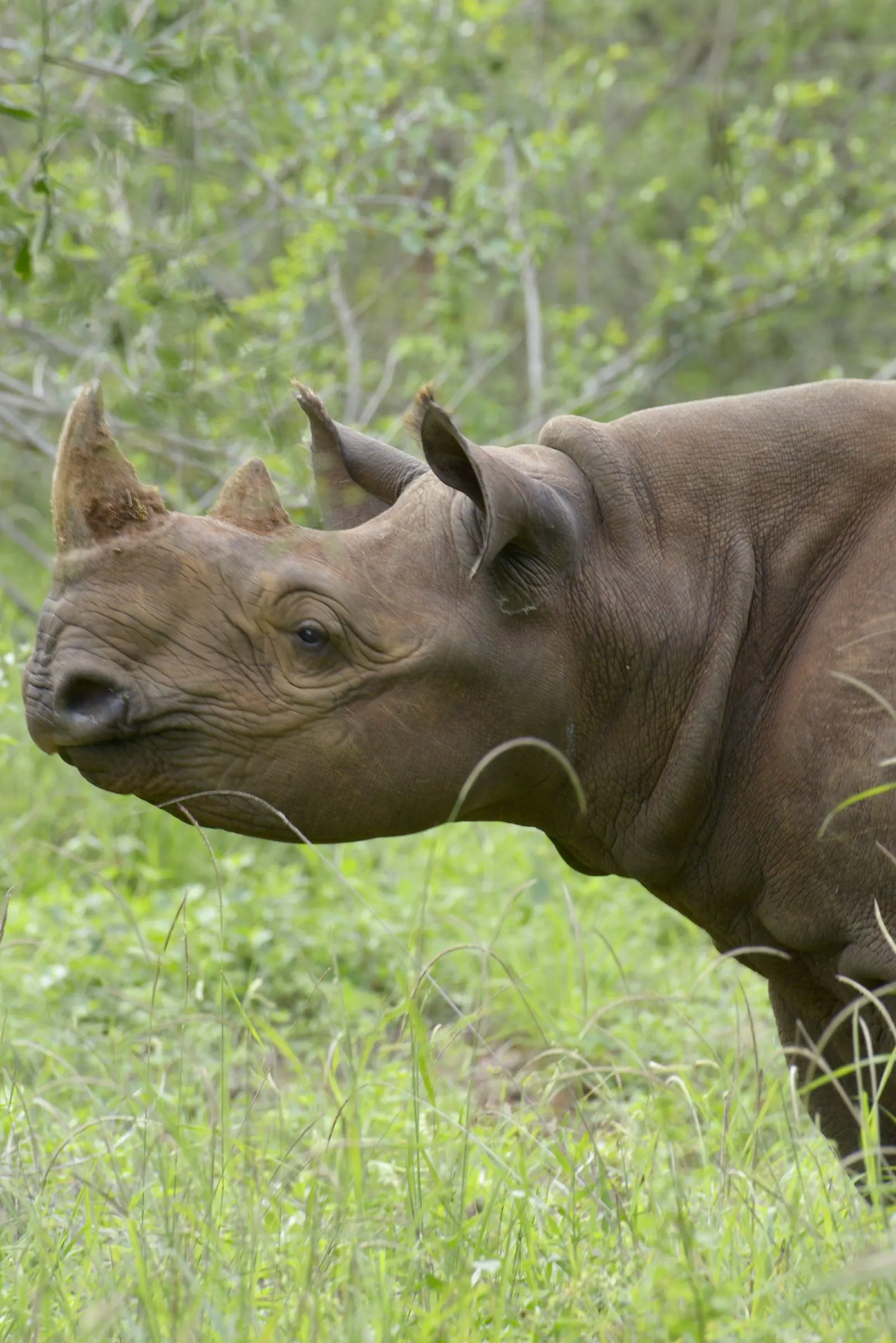
If you are asking where to see the Big Five, the Ngorongoro Crater is the usual answer. Its floor, roughly 610 m / 2,000 ft below the rim and about 260 square km / 100 square miles, holds lions, elephants, buffalo and leopards alongside one of East Africa's last viable groups of critically endangered black rhino. Seeing all five in a single day there is realistic, though still not certain, and the rhino are often far out on the open floor.
The Serengeti offers a different kind of Big Five story. Lions, leopards, elephants and buffalo are all present in good numbers, while rhino are very few and carefully protected, so most visitors who want the full set pair the Serengeti with the crater. Tarangire and Ruaha are excellent for four of the five without the rhino, and with far fewer vehicles at each sighting.
- Lion: Serengeti, Ngorongoro Crater, Ruaha, Nyerere, Lake Manyara.
- Leopard: Seronera area of the Serengeti, Tarangire, Ruaha, Nyerere.
- Elephant: Tarangire, Ruaha, Nyerere, Serengeti, Ngorongoro Crater.
- Cape buffalo: almost everywhere, with huge herds in Katavi and the Serengeti.
- Black rhino: the Ngorongoro Crater is the most reliable place in the country.
03
Lions and the best time to see lions in Tanzania
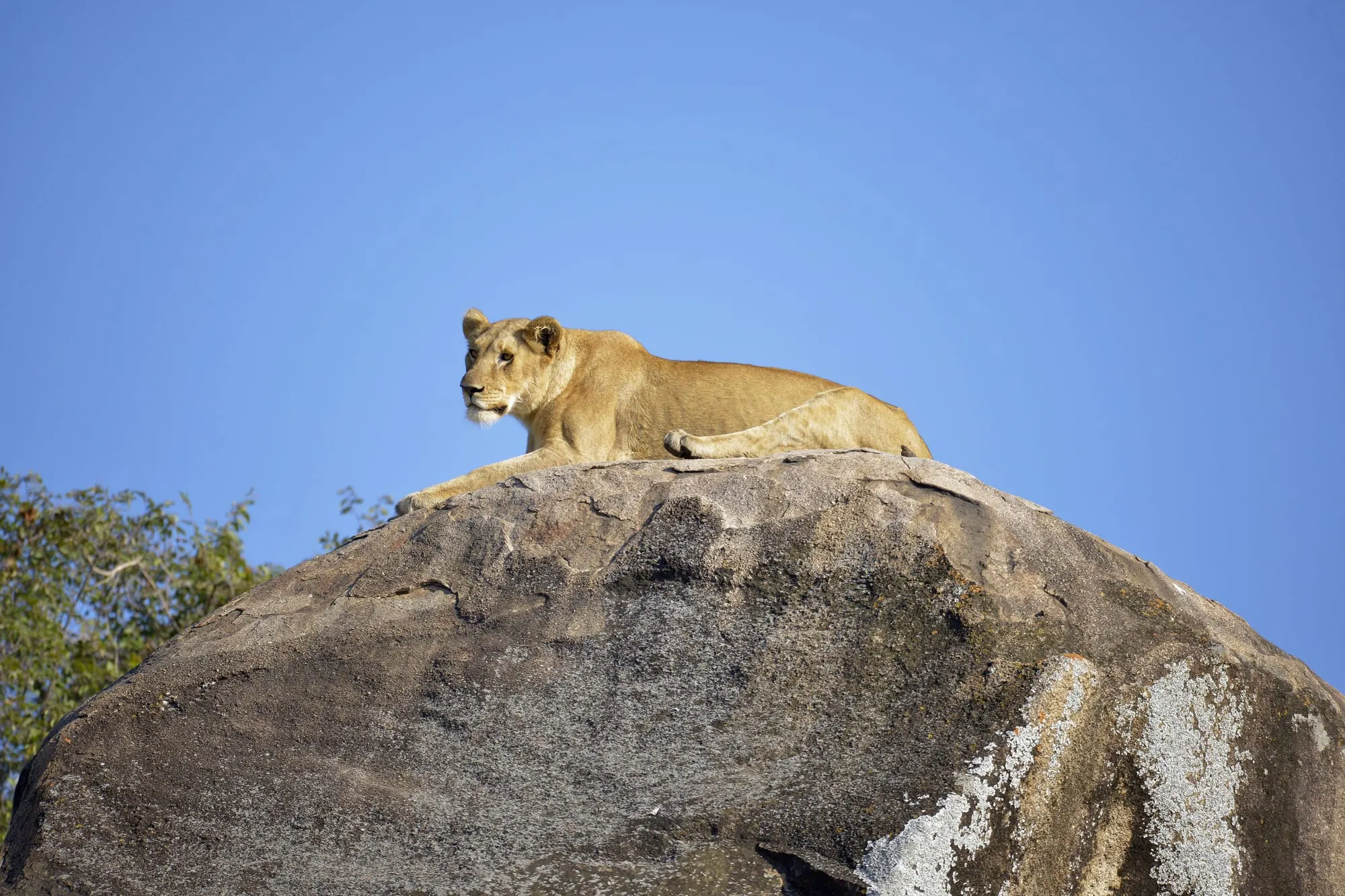
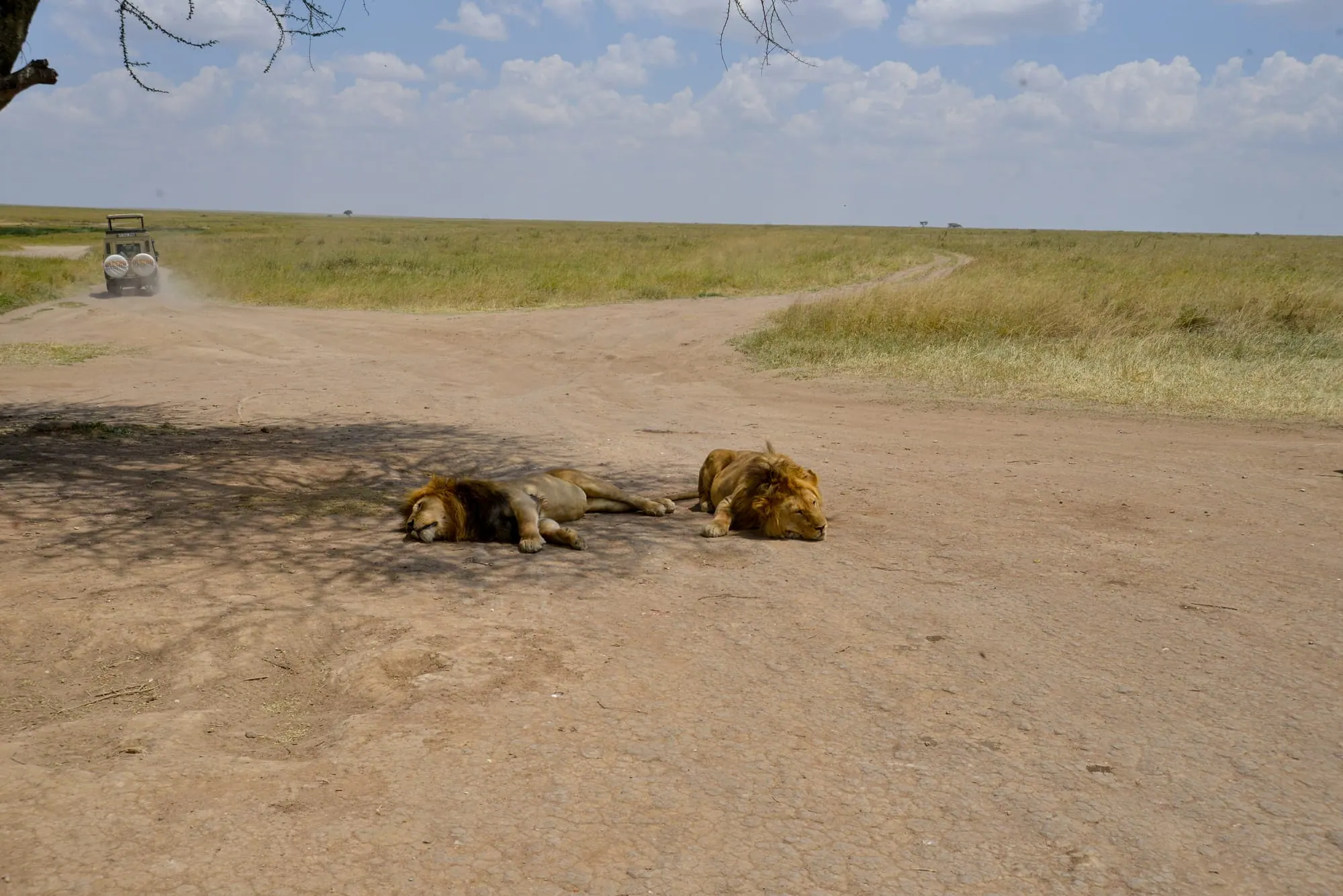
Lions are the animal most visitors dream of, and Tanzania has plenty. They spend most of the day asleep, often twenty hours out of twenty four, so a first sighting is usually a tawny shape flat in the grass or draped over a rock. The granite kopjes of the Serengeti are favourite lookouts, and a lioness stretched along a boulder is one of the most common and rewarding sights on the plains.
The best time to see lions in Tanzania depends on what you want to watch. In the dry months from June to October, water is scarce, prides are easier to find near rivers and hunting is frequent. From January to March the short grass around Ndutu fills with newborn wildebeest and zebra, and lions follow. Early morning and late afternoon are best in every season, because the cats are on the move and the light is kind.
The tree-climbing lions of Lake Manyara are well known. Prides there are reported to rest in the branches of acacia and sausage trees, probably to escape heat and biting flies, and Tarangire has similar stories. We always say reported, not guaranteed: it is a delightful bonus when it happens, and it should never be the reason you choose a park. Your guide will know where the pride was last seen.
04
Leopards, cheetahs and the smaller cats
Leopards are the shy ones. They hunt at night, rest by day in trees or thick cover, and are the Big Five animal that visitors most often miss. If you are wondering where to see leopards in Tanzania, start along the Seronera River in the central Serengeti, where large fig and sausage trees line the water. Tarangire, Ruaha and Nyerere also have healthy populations, and a patient guide will check every likely branch.
Cheetahs are creatures of the open. They hunt by day, so cheetah hunting on the plains is something you can genuinely hope to watch, usually in the short grass of the southern Serengeti and Ndutu in the early part of the year. A cheetah will often climb a termite mound or even your vehicle's bonnet to gain a view. Please keep still and quiet if one does, and let the animal decide how close it wants to be.
Then there are the small cats, which reward a sharp eye. A serval has enormous ears, long legs and a spotted coat, and is most often seen at dawn or dusk pouncing on rodents in tall grass, in places like the Ngorongoro Crater and the Serengeti. A caracal, with its tufted black ears, is far rarer. A glimpse of serval and caracal is a gift, not something anyone can plan for.
05
Elephants, buffalo and rhino
Tarangire elephants are one of the park's great draws. In the dry season from about June to October, the Tarangire River is the main water for miles around, and herds of elephant gather along it in numbers that can reach dozens at a time, sometimes with tiny calves tucked between the legs of the adults. Ancient baobab trees stand all around, and the combination of grey bodies and enormous trunks makes for superb viewing.
Cape buffalo look placid but are among the most respected animals in the bush. Old bulls often stay on their own or in small groups and can be bad tempered, while the breeding herds move together in hundreds or more. Buffalo are the main prey of lions in many areas, so a big herd is often followed by a pride. Oxpeckers riding on their backs and eating ticks are a fine thing to photograph.
Rhino are the rarest of the five. Black rhino in Ngorongoro Crater are visible at a distance, and a view through binoculars is usual, with a close approach the exception. These animals were hunted almost to extinction across East Africa, and the small surviving groups are guarded closely. Your guide will stay well back, speak quietly and may decide to leave an animal alone if it seems unsettled. That restraint is part of why they survive.
06
Wild dogs, hyenas and the other predators
The African wild dog is one of the continent's most endangered carnivores, and seeing a pack is a real privilege. Wild dogs in Ruaha and Nyerere are the best bet in Tanzania, and both parks are large, wild and lightly visited. Packs roam over huge ranges, den in a fixed place for a few months each year, and can vanish for weeks. If you hope to see them, give the trip several days in the south and keep your hopes open, not fixed.
The spotted hyena has an unfair reputation as a scavenger. In reality it is a skilled hunter that kills most of its own food, lives in tight clans led by females and communicates with a surprising range of whoops, giggles and groans. Hyenas are active at night, and the Ngorongoro Crater is a good place to see them at their dens, with cubs playing at the entrance in the early morning.
Jackals, bat-eared foxes and honey badgers also deserve a mention. Black-backed and golden jackals trot across the plains looking for scraps, and bat-eared foxes use their huge ears to listen for insects underground. The honey badger, which gave Lemala Safaris its emblem, is rarely seen, tough, fearless and quite capable of making a lion think twice. If you see one, tell everyone in the vehicle.
07
Giraffe, zebra, wildebeest and the great herbivores
The Maasai giraffe is Tanzania's national animal, and it is easy to see why people love it. Tall, patterned in jagged patches, it browses on the tops of acacia trees and walks with a slow, swaying gait. You will find giraffe in almost every northern park, often in loose groups called towers. They look serene, but watch for the dramatic sight of two males swinging their necks at each other in a slow, heavy duel.
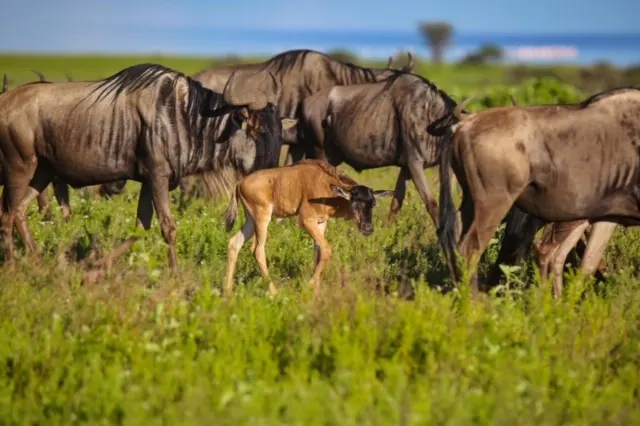
Zebra and wildebeest are the backbone of the plains. Their numbers rise and fall with the rains, and in the Serengeti the great herds follow the grass through the year. If you want to see zebra and wildebeest in huge numbers, think about the calving months in the south from January to March, or the river crossings in the north from about July to October. The animals are on the move wherever the grass is greenest, so ask your guide where they are now.
Smaller antelope add endless variety: impala, Thomson's gazelle, Grant's gazelle, waterbuck, eland, topi, hartebeest and the tiny dik-dik, which pairs for life. In the south, Ruaha and Nyerere add sable and roan antelope and greater kudu, species you will not see in the northern circuit. These animals are the food chain made visible, and watching how they graze, flinch and bunch up tells you where the predators are.
08
Water animals: hippos and crocodiles
Hippo pools are one of the great pleasures of a safari. Hippos spend the day submerged to protect their skin from the sun, then leave the water at dusk to graze on grass, sometimes walking several kilometres. They are responsible for more human deaths in Africa than most other large animals, so stay in the vehicle, and never get between a hippo and the water. The pool near Seronera in the Serengeti is a dependable place to hear their grunts.
In the dry season, Katavi National Park offers one of Africa's most overlooked spectacles. As the Katuma River shrinks, thousands of hippos are squeezed into smaller and smaller pools, and the result is a noisy, crowded scene with fighting and sparring. Buffalo, elephant and lion gather as well, and the park sees only a handful of visitors. The best months are July to October.
The Nile crocodile is the other water giant. Large crocodiles lie on sandbanks with their mouths open, and in the Serengeti they wait at the Mara and Grumeti river crossings for migrating wildebeest. Some of the biggest are old, scarred and patient. Nyerere National Park, with its boat safaris on the river system, is the place to watch crocodiles and hippos from water level.
09
Primates: chimpanzees, colobus and baboons
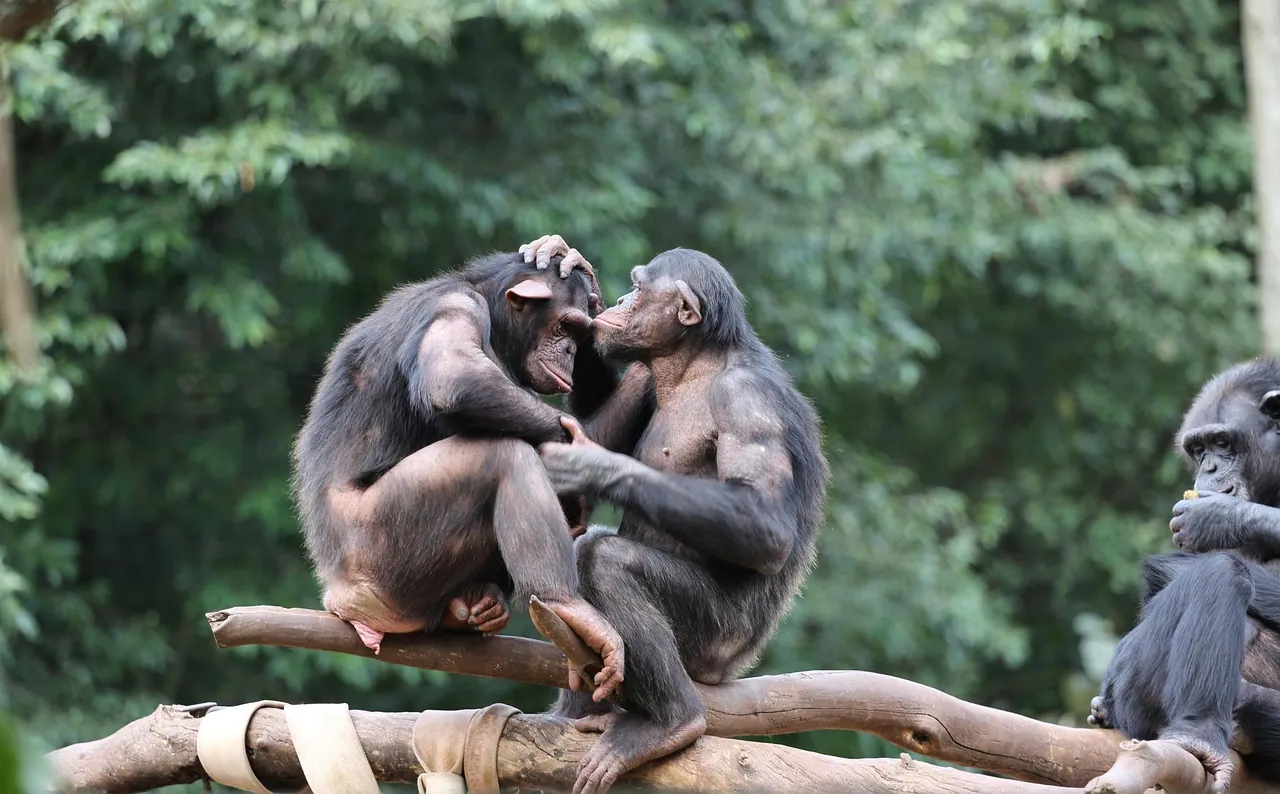
Tanzania's western parks hold some of the last wild chimpanzees in East Africa. Chimpanzee trekking in Mahale, on the shore of Lake Tanganyika, means walking with trackers through forest to find a group that is moving, feeding or resting, then spending a strictly limited time with them. It is remote, demanding and unlike a normal safari. Gombe Stream, made famous by Jane Goodall's research, is the other main chimp destination, and both are best from about May to October.
Red colobus monkeys on Zanzibar live in the Jozani Forest, the largest remaining area of natural forest on the island. This subspecies is found nowhere else, and it is endangered. The monkeys are used to people and often come down to eye level, which makes them wonderfully easy to photograph. Walking tours are guided and short, so Jozani pairs easily with a beach stay.
Elsewhere, you will meet baboons and monkeys on almost any safari. Olive and yellow baboons patrol the roadsides, vervet monkeys steal from picnic tables, and blue monkeys and black-and-white colobus live in the forests around Lake Manyara and Arusha National Park. Troops are lively to watch, with grooming, squabbling and play to see, and it is wise to keep food well out of sight.
10
Birdlife in Tanzania and the small things
Birdlife in Tanzania is exceptional, with over a thousand species recorded across the country, and even a first time visitor will notice the colour. The lilac-breasted roller, with a blue, lilac and green plumage, perches on every second bush. The secretary bird strides through the grass stamping on snakes. Ostriches, kori bustards, hornbills, vultures, fish eagles and grey crowned cranes round out a lengthy, rewarding list.
Flamingos are the great water spectacle. Flamingos at Lake Magadi, the soda lake on the Ngorongoro Crater floor, and on Lake Manyara can gather in thousands when conditions suit, turning the shoreline pink. Numbers vary with water levels and the season, so treat them as a possibility, not a promise. The wetter months from about November to May bring migrant birds and breeding plumage, which is when birders do best.
Do not overlook the small things. Dung beetles rolling a ball of elephant dung across the road are more entertaining than they sound, and your guide will gladly stop for them. A troop of dwarf mongoose pops in and out of a termite mound with its members on constant watch. Agama lizards, chameleons and weaver birds building nests are small stories that fill the quiet hours between big sightings.
11
How guides find animals and how to spot predators
How guides find animals is mostly a matter of reading signs, not luck. They watch vulture circles, listen for the alarm calls of impala, monkeys and birds, and look at fresh tracks in the dust. They notice which way the zebras are all facing. Radio chatter between guides helps as well, and a good guide will tell you honestly when a sighting is already crowded and offer a quieter alternative.
If you want to learn how to spot a leopard, look for the shape that is wrong. A branch with a bulge, a pale tail hanging down, or a flicker of a white-tipped ear. Leopards pick a branch above the grass and wait. Signs of predators on the ground include a sudden nervous stillness among grazers, a line of vultures on the ground or a hyena trotting with purpose. Scan slowly with binoculars, and let your eyes rest on the shadows.
Animal behaviour on safari is worth watching as much as the species list. Notice the lioness that crouches low and stops, the elephant that flaps its ears and shakes its head to warn you, or the zebra that lifts its tail. Staying quiet, turning off engines and giving a sighting twenty minutes often reveals more than driving on to the next one. Ask your guide questions, because they love to explain.
12
Best time for wildlife viewing and realistic expectations
The best time for wildlife viewing in Tanzania is usually the dry season from June to October. Dry season game viewing is easier because the grass is short, water is scarce and animals concentrate along rivers and waterholes. A second, shorter window from January to February is excellent too, with calving on the southern Serengeti plains. The green months of March to May are quieter, often cheaper and good for birds, but the grass is long and some tracks are slow.
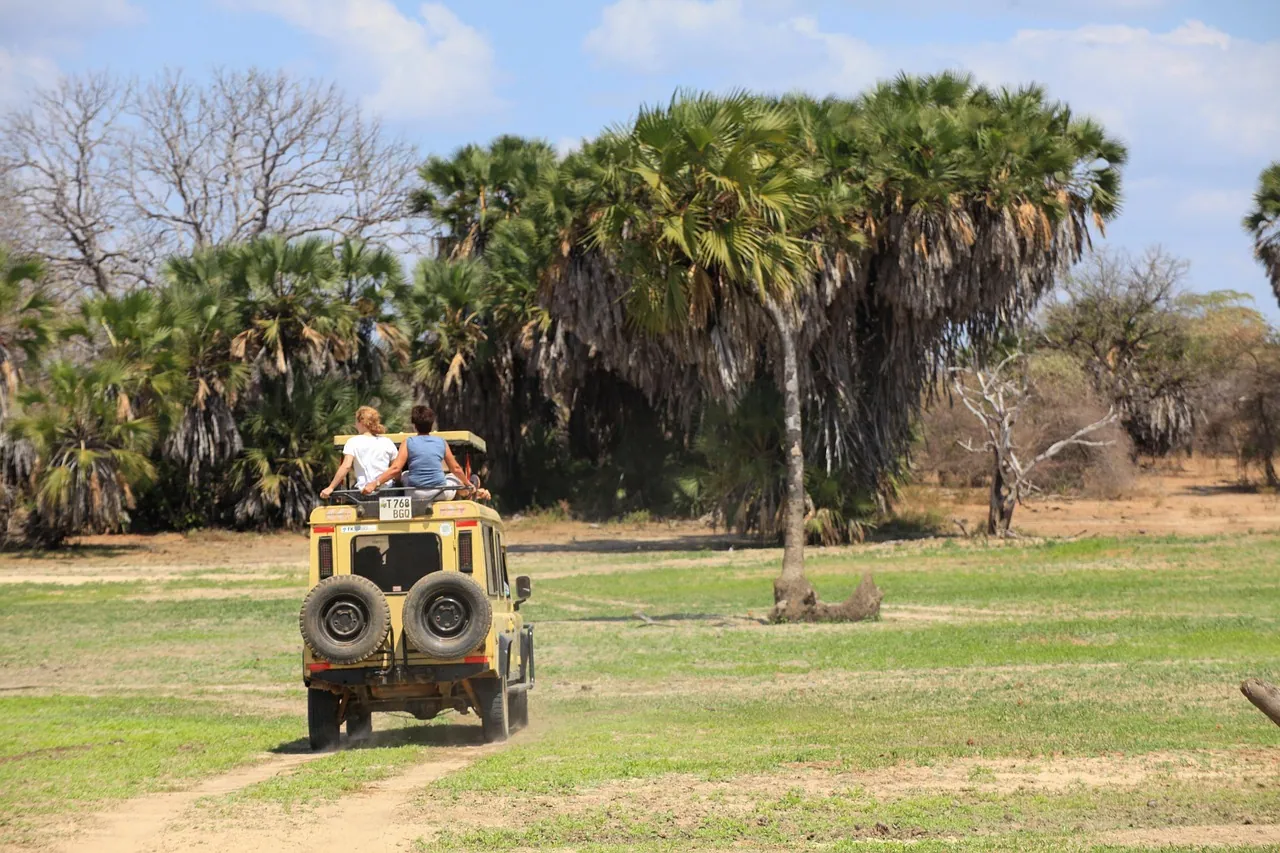
An early morning game drive is almost always better than a late one. Predators are active in the cool hours, the light is soft and the animals have not yet retreated into shade. Many travellers also underestimate how much a day in the Ngorongoro Crater or Tarangire has to give when you leave the lodge at first light. Ask whether a picnic lunch in the park suits your itinerary, because it saves precious time.
Finally, realistic expectations on safari make for a happier trip. You might see a kill on day one and no cats at all on day three. You may spend an hour with a single cheetah and love it. The more days you give a safari, and the more flexible you are, the more the bush will show you. We would rather you came home with a few deep sightings than a long list of brief ones.
- June to October: best overall game viewing, river crossings in the northern Serengeti.
- January to March: calving and predators on the southern plains.
- April to May: green season, fewer vehicles, long grass.
- November to December: short rains, migrant birds, fresh green landscapes.