Safari costs
How much does a Tanzania safari cost?
A clear, honest breakdown of what a Tanzania safari costs: real starting prices from our own itineraries, what moves the price up or down, what is included, and how to compare one quote with another.
- $1,350
- Lowest starting price, per person
- $270
- Lowest starting price, per person per day
- 31
- Safaris priced on this page
- 3 levels
- Trail, Ridge and Summit
The short answer
A Tanzania safari costs different amounts for different people, because the word safari covers a whole range of choices. Two guests can both book a week in the bush and pay very different totals depending on where they sleep, how they travel between parks, how many people share the vehicle and which month they go.
What we can do is show you real numbers. The table below lists the starting price per person for every safari we run, at our Trail level and sharing a room, with the price per day alongside it. Ridge and Summit cost more, and the tier example further down shows by how much on one real itinerary.
Think of the price as layers. The fixed charges paid to the parks sit at the bottom. On top go your choices: accommodation, season, group size, length and how you travel between parks. Once you see the layers, any quote from any operator becomes easy to read.
Tanzania safari prices, safari by safari
Starting prices per person for each of our safaris, from the shortest to the longest. The per-day figure is simply the starting price divided by the number of days, so you can compare a short trip with a long one.
Starting rates in US dollars, per person sharing, at our Trail level. Ridge and Summit cost more, and your personal quote confirms the exact price for your dates and group.
Trail, Ridge and Summit: the three accommodation levels
After park fees, where you sleep has the biggest effect on the total. We group the partner stays we book into three collections so you can compare like with like. These are what most people mean by a budget, mid-range or luxury Tanzania safari.
Trail
Our great value collection: comfortable, clean rooms or tents and friendly camps in excellent locations. A Trail camp is not a poor camp, and it is often the best way to spend more of your budget on the wildlife itself.
Ridge
Adds character, generous rooms and standout settings. A popular middle choice for couples and families who want a little more space and atmosphere.
Summit
Our luxury collection: private suites, refined service and prime, often remote, positions. Many guests mix levels, spending a few nights at Summit stays in the park they care about most and choosing Trail elsewhere.
What the levels and group size do to the price
Here is one real itinerary, our seven-day Serengeti, Ngorongoro and Tarangire safari in high season, priced at all three levels for different group sizes. Notice two things: the step up from one level to the next, and how the price per person tends to fall as more people share the vehicle and guide, with small variations between group sizes.
| Travelling together | Trail | Ridge | Summit |
|---|---|---|---|
| 2 travellers | $3,501 | $4,382 | $5,774 |
| 3 travellers | $2,896 | $3,845 | $5,186 |
| 4 travellers | $2,843 | $3,837 | $5,117 |
| 5 travellers | $2,585 | $3,376 | $4,875 |
| 6 travellers | $2,649 | $3,530 | $4,922 |
Price per person for the Serengeti, Ngorongoro and Tarangire in Seven Days, high season, sharing a double or twin room. Your personal quote confirms the exact price for your dates and group.
What drives the price of a Tanzania safari
Eight things decide the total. Some you can change, and some are fixed, so it helps to know which is which.
Park and conservation area fees
Usually the largest single item. Fees are set by the authorities, charged per person per day, and the same for every operator. A safari with more days in the Serengeti or the crater costs more than one with the same days in a quieter park.
Where you sleep
Trail, Ridge or Summit. This is the easiest lever to move without changing the quality of the wildlife viewing, because a lion does not know which pillow you slept on.
Season
Camps price by demand. Our high season runs from June to September and from December to February, and green-season rates in the other months can be gentler.
How long you stay
Cost is counted per night, but transfers and flights are spread over more days on a longer trip, so each extra day is a little cheaper. For a first trip, five to seven nights in the bush is a good length.
Group size
The vehicle, fuel and guide cost roughly the same for two people as for six, so a family or group of friends often pays less per head than a couple travelling alone.
Flying or driving between parks
Road transfers cost less and show you the country. A fly-in safari saves hours of driving and adds the cost of the tickets. Many trips mix both.
Guide and vehicle
The most valuable part of any safari. A well-kept 4x4 with a window seat for every guest, and an experienced guide, are the last places to cut.
Extras
A dawn balloon flight, a walking safari, a night drive or a Zanzibar beach finish each add their own cost. Pick one or two that speak to you rather than adding all of them.
Why the same room costs different amounts in different months
Lodges and camps price their rooms by season, and the pattern follows demand. The main dry months, roughly June to October, and the short dry spell around January and February, are the busy high season. The roads are firm, the animals gather near water and everyone wants to be there, so rates rise and the best camps fill early.
The long rains, typically March to May, and the short rains in November bring the green season. The plains turn a deep green, the light is wonderful for photographers and the parks are quiet. Camps often lower their rates, and a few close for a stretch. If your dates are flexible, travelling just outside the peak can ease the total without costing you a good safari.
Wildlife events follow their own calendar, and camps near an event price for demand. The calving season on the southern plains and the river crossings in the north fall in different weeks. Ask your planner what is happening in your chosen week, then decide whether the premium is worth it to you. Our best time to visit Tanzania guide shows how each month compares.
- High season: June to September and December to February.
- Green season: March to May and November, with gentler rates and fewer vehicles.
- Busiest weeks: the Christmas and New Year weeks and the peak migration weeks.
What is included in a Tanzania safari price, and what is not
Reading the inclusions matters as much as reading the number. On our itineraries the price typically covers the following.
Usually included
- National park and conservation area entry fees
- Game drives in a 4x4 safari vehicle
- A professional local guide for the whole trip
- The meals listed in the daily plan
- The lodging listed in the itinerary
- Private transfers from the airport and between camps
Usually not included
- International flights
- Visa fees
- Travel insurance
- Gratuities for guides and camp teams
- Optional activities such as a balloon flight
- Drinks, laundry and personal spending at some camps
Be careful with a safari that looks far cheaper
A low price is not a fault in itself, and a Trail itinerary can be wonderful value. But when a quote is far below the others, the saving usually comes from somewhere you cannot see: an older vehicle, an inexperienced guide, an overloaded car, or park fees that are not actually in the price. Ask about all four before you celebrate.
What about the cost of climbing Kilimanjaro?
A Kilimanjaro climb follows its own logic. Park fees are charged per person per day on the mountain, so a longer route costs more simply because you spend more days inside the park. The crew matters too: guides, a cook and porters, with fair wages, sensible loads and proper kit.
We list a price for each of the six routes by group size on our Kilimanjaro climb cost guide, and each route page shows what is included.
How to budget for a safari, step by step
- 01
Decide the shape of the trip
Choose the length, the parks and the feel you want before you think about the number.
- 02
Ask for a quote on that plan
A good quote states the price per person sharing, the dates, the camps by name, the inclusions and the exclusions.
- 03
Add a reserve
Allow a sensible cushion for gratuities, optional activities, drinks and souvenirs, so you do not spend the last days counting.
- 04
Rebalance if you need to
If the total is too high, a planner can often move a night from one level to another, trim a park or shift the dates without spoiling the trip.
How to compare safari quotes fairly
Two quotes that look alike on the surface can differ a great deal underneath. Line them up on the same basis.
The trip
- Number of nights and parks
- Accommodation level and the exact camps
- Which meals are covered
The vehicle and guide
- Vehicle type and how many guests share it
- A window seat for every guest
- Guide experience and training
The money
- Park fees inside the price
- Domestic flights included or not
- Deposit and balance dates
The small print
- What can change if park charges change
- Cancellation terms
- Tipping guidance
Reading your price and paying for it
Payment usually happens in two parts. A safari deposit confirms your booking, and the balance follows before you travel. The size of the deposit and the date of the balance are set for each trip and written in your quote and invoice, so you know the amounts and dates before you pay anything.
Park charges are fixed by the authorities and can change at short notice, which is why our notes say so plainly. Our payments page explains the steps and how to pay safely, and our booking terms set out the conditions.
Questions answered
What travellers ask us
It depends on the length, the parks, the accommodation level, the season and how many people share the vehicle. The table above lists the starting price per person for each of our safaris, at our Trail level and sharing a room. Ridge and Summit cost more, and a personal quote confirms the exact price for your dates and group.
The table above shows the starting price per day for each safari, found by dividing the starting price by the number of days. Longer trips tend to cost a little less per day, because transfers and flights are spread over more days.
It can be one of the larger trips people take, mainly because park fees are high and charged per person per day, and a private vehicle and experienced guide are a real cost. The good news is that you control much of the total through your choice of accommodation level, season, group size and length.
The green season, March to May and November, usually has gentler rates and fewer vehicles. April is the quietest month. The trade-off is rain, and some camps close in the wettest weeks, so it suits flexible travellers.
On our itineraries the price typically includes park and conservation area fees, game drives in a 4x4 safari vehicle, a professional local guide, the meals and lodging listed in the plan, and private transfers. International flights, visas, travel insurance, gratuities and optional activities are not included.
Yes. Park and conservation area entry fees are typically part of the price on our itineraries, and your quote lists them. They are set by the authorities and can change at short notice, so the quote you accept is the price that applies.
A private vehicle costs more per person than a shared one but gives you control of the day, and the price per person falls as more people share the vehicle and guide. Every Lemala safari is private, so the vehicle and guide are yours.
Prices are per person sharing a double or twin room. A solo traveller who wants a room alone will normally pay a single supplement, because the room costs the same whether one or two people sleep in it.
Gratuities for guides, camp teams and porters are customary and are handled separately from the trip price. We share guidance on how and when to tip before you travel.
The size of the deposit and the date of the balance are set for each trip and written in your quote and invoice, so you know the amounts and dates before you pay anything.
Keep planning
Where to go next
Best time to visit Tanzania
Month by month, so you can match your dates to the wildlife and the weather.
Read moreKilimanjaro climb cost
Route prices by group size, and what drives the cost of a climb.
Read moreWhere you will stay
Browse the Trail, Ridge and Summit camps and lodges.
Read moreTalk to a planner
Book a call and get a personal quote for your dates.
Read more
Free guides
Take the planning with you
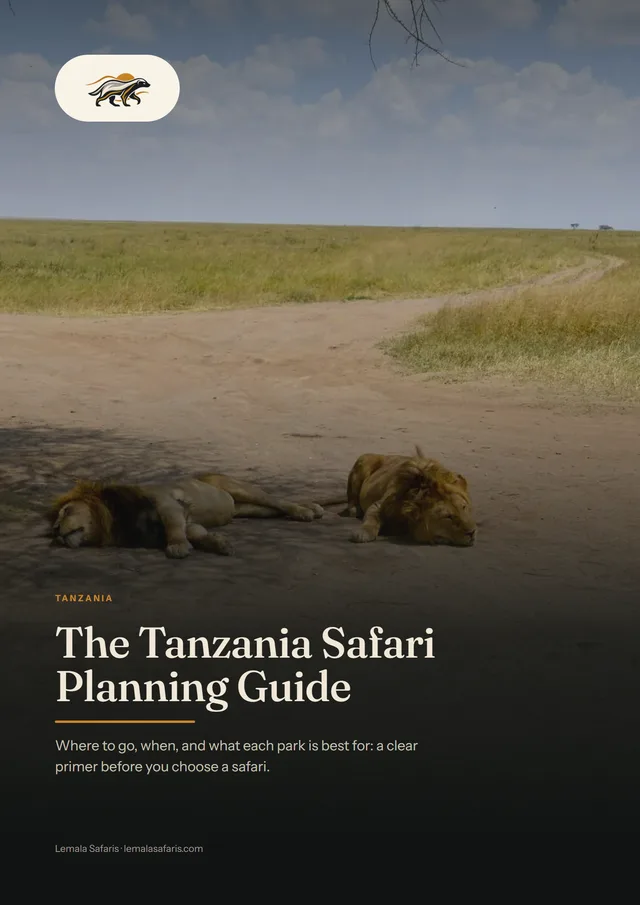
A free PDF to read at your own pace: where to go, when, and what each park is best for. Tell us where to send it.
 Free PDF
Free guide
The Tanzania Safari Planning Guide
Where to go, when, and what each park is best for: a clear primer before you choose a safari.
- The best months for every park, park by park, on one page
- A profile of each destination: the landscape, the wildlife to expect and the size of the park
- The ways to travel, from classic game drives to walking, beach and combination trips
Your Tanzania journey
Ready to plan your Tanzania safari?
Tell us when you would like to travel and what you hope to see, and we will shape a private trip around you.
No obligation and no pressure. We reply personally.
- 01
Tell us what you love
Dates, who is travelling and the moments you are dreaming of. Two minutes is enough.
- 02
A real person replies
A Lemala planner writes back personally with ideas, not a template.
- 03
Get your tailored plan
A day-by-day itinerary and a clear quote, shaped around you. No obligation.